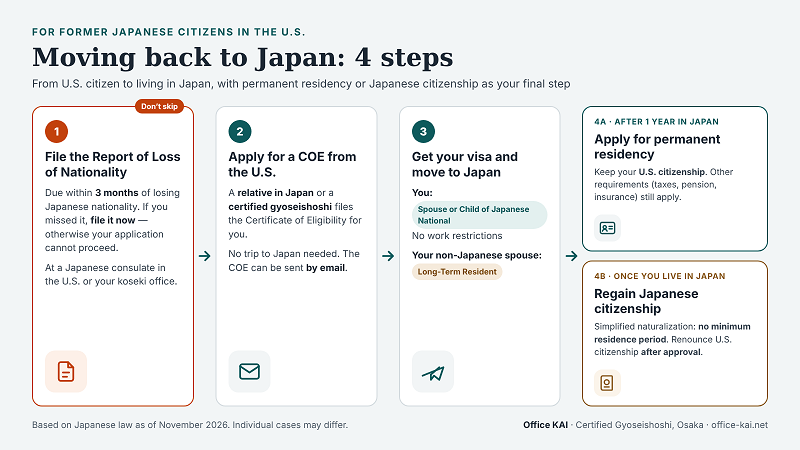
You were born Japanese, built your life in the United States, and became a U.S. citizen.
Now you are thinking about returning to Japan — to be closer to family, to care for aging parents, or to spend your retirement at home.
The good news: former Japanese citizens have one of the easiest paths back to Japan.
This guide explains which visa you can get, how to apply while still living in the U.S., and how to obtain permanent residency or even regain Japanese citizenship.
Key takeaways
Former Japanese citizens can usually live in Japan with no work restrictions
- Most former Japanese citizens qualify for the “Spouse or Child of Japanese National” status, which has no restrictions on work.
- You can start the application while still in the U.S. — a relative in Japan or a certified immigration lawyer (gyoseishoshi) can file for you.
- You may apply for permanent residency after just 1 year of living in Japan.
- You can also regain Japanese citizenship through simplified naturalization, but you must give up your U.S. citizenship.
First: Did you lose your Japanese nationality?
Under Japan’s Nationality Act (Article 11, Paragraph 1), a Japanese national who voluntarily acquires a foreign nationality automatically loses Japanese nationality.
If you took the U.S. Oath of Allegiance as an adult, you lost your Japanese nationality at that moment — Japan does not allow you to keep both.
This is different from people who were born with both nationalities (for example, a child born in the U.S. to a Japanese parent).
They may hold dual nationality until they must choose one by age 20.
Have you filed the “Report of Loss of Nationality”?
- After becoming a U.S. citizen, you must file a Report of Loss of Nationality (Kokuseki Soshitsu Todoke) within 3 months of learning that you lost Japanese nationality.
- It can be filed at a Japanese Embassy or Consulate in the U.S., or with your registered domicile office in Japan.
- If it has not been filed, your family register (koseki) still lists you as Japanese, and your visa application cannot move forward. If you missed the deadline, file it now.
- Using a Japanese passport after losing Japanese nationality is a punishable offense.
Which visa can you get?
Your visa (residence status) depends on whether your parent was a Japanese national when you were born.
Find the case closest to you and your family.
| Who you are | Residence status | Basis |
|---|---|---|
| Former Japanese citizen (born Japanese, later became a U.S. citizen) | Spouse or Child of Japanese National | “Born as a child of a Japanese national” (Immigration Control Act, Appended Table II) |
| Child of a Japanese national (your father or mother was Japanese when you were born) | Spouse or Child of Japanese National | Same as above |
| Child of a former Japanese citizen (born after your parent had already lost Japanese nationality) | Long-Term Resident | Long-Term Resident Notice No. 3 (good conduct required) |
| Grandchild (third generation) | Long-Term Resident | Long-Term Resident Notice No. 3 or No. 4, depending on your parent’s birth status |
What about my spouse and children?
| Family member | Residence status | Basis |
|---|---|---|
| Your non-Japanese spouse (while you live in Japan with the “Spouse or Child of Japanese National” status) | Long-Term Resident | Long-Term Resident Notice No. 5 |
| Your minor, unmarried children | Depends on when and where they were born | See the table above, or ask us |
Families often apply together.
It is best to check everyone’s status at the same time before you start.
How to apply while you are still in the U.S.
To move to Japan, you first obtain a Certificate of Eligibility (COE) from the Immigration Services Agency of Japan.
You do not need to travel to Japan to apply.
Who can file the application for you?
| Who | Notes |
|---|---|
| A relative living in Japan | Siblings, cousins, or other relatives in Japan can apply as your agent. |
| A certified gyoseishoshi (immigration lawyer) | Even if you have no relatives in Japan, a gyoseishoshi registered with the Immigration Services Agency can file on your behalf. |
Step-by-step process
- 1. Check your statusConfirm which residence status you and your family qualify for
- 2. Report of LossMake sure your Report of Loss of Nationality has been filed
- 3. Gather documentsJapanese family registers, U.S. birth and naturalization certificates, etc.
- 4. Apply in JapanYour relative or gyoseishoshi files the COE application
- 5. ReviewUsually about 1–3 months
- 6. Receive the COE by emailSince March 2023, the COE can be issued electronically
- 7. Apply for a visaShow the COE email at a Japanese consulate in the U.S.
- 8. Move to JapanEnter within 3 months; receive your Residence Card at the airport
Main documents
| Prepared in Japan | Prepared in the U.S. |
|---|---|
| • COE application form and photo • Your parent’s family register (koseki or joseki) • Letter of guarantee • Guarantor’s certificate of residence | • Birth certificate (with Japanese translation) • Certificate of Naturalization (copy, with translation) • Passport copy • Proof of pension or savings (recommended) |
About the guarantor: The application requires a letter of guarantee. The guarantor does not have to be a relative — a friend or acquaintance living in Japan can serve. The guarantor’s responsibility is moral rather than legal.
About income: For a former Japanese citizen applying as the child of a Japanese national, financial stability is not a formal requirement.
Still, submitting proof of pension or savings helps show that you can live stably in Japan.
Permanent residency: possible after 1 year
Under the Immigration Services Agency’s Permanent Residency Guidelines, the child of a Japanese national may apply for permanent residency after living in Japan continuously for 1 year or more.
The usual requirement for most foreign nationals is 10 years.
Other requirements still apply, such as paying taxes, pension, and health insurance properly, and holding the longest available period of stay for your current status.
Those with the Long-Term Resident status generally need 5 years.
Regaining Japanese citizenship
If you want to become Japanese again, you can apply for naturalization.
Former Japanese citizens benefit from simplified naturalization under Article 8, Item 3 of the Nationality Act.
| Requirement | Regular naturalization | Former Japanese citizen |
|---|---|---|
| Residence in Japan | 5+ consecutive years | No minimum period (but you must live in Japan) |
| Age | 18 or older | Not required |
| Financial stability | Required | Not required |
| Good conduct | Required | Required |
| Giving up other nationality | Required | Required |
- ✓ You must live in Japan and apply in person at the Legal Affairs Bureau — you cannot apply from the U.S.
- ✓ Japanese language ability is checked through a handwritten statement and an interview (roughly 3rd–4th grade level)
- ✓ The review generally takes around 1 year
- ✓ After approval, you must promptly renounce your U.S. citizenship
Permanent residency or citizenship: which is right for you?
| Permanent residency | Japanese citizenship | |
|---|---|---|
| Nationality | Stay a U.S. citizen | Japanese (U.S. citizenship renounced) |
| When you can apply | After 1 year in Japan | Any time after you establish residence in Japan |
| Passport | U.S. | Japanese |
| Residence Card | Required (renewed every 7 years) | Not required |
| Voting in Japan | No | Yes |
| Best for | Those who want to keep ties to the U.S. | Those who want to live in Japan as Japanese |
Frequently asked questions
Q. I have no relatives in Japan. Can I still apply?
Yes. A certified gyoseishoshi can file the application for you, and your guarantor can be a friend or acquaintance living in Japan.Q. Do I need to visit Japan before moving?
No. The COE application, the visa, and all preparation can be completed while you are in the U.S. You only come to Japan when you move.Q. I am retired and have no income in Japan. Is that a problem?
Income is not a formal requirement for former Japanese citizens applying as the child of a Japanese national. We recommend submitting proof of pension or savings to show you can live stably.Q. Can I keep both U.S. and Japanese citizenship?
No. Japan does not allow dual nationality for people who naturalize. If you want to keep your U.S. citizenship, permanent residency is the better choice.Q. Can you help in English?
Yes. Consultations are available in English via Google Meet, and we handle all the Japanese paperwork and communication with the immigration office for you.
Summary
Former Japanese citizens can usually return to Japan with the “Spouse or Child of Japanese National” status, which has no work restrictions, and may apply for permanent residency after 1 year.
The key steps are: file your Report of Loss of Nationality, gather your Japanese family registers early, and find a guarantor in Japan.
Consultations available in English
We handle the Japan side of your move — while you stay in the U.S.
From obtaining your Japanese family registers to preparing documents and filing with the Immigration Services Agency, a certified gyoseishoshi in Osaka manages the entire process. Free 1-hour first consultation via Google Meet.
This article is based on Japanese laws and regulations as of November 2026.
For questions about U.S. citizenship, taxes, or Social Security, please consult a U.S. professional.


コメント