A Quiet but Major Shift, Four Years Away
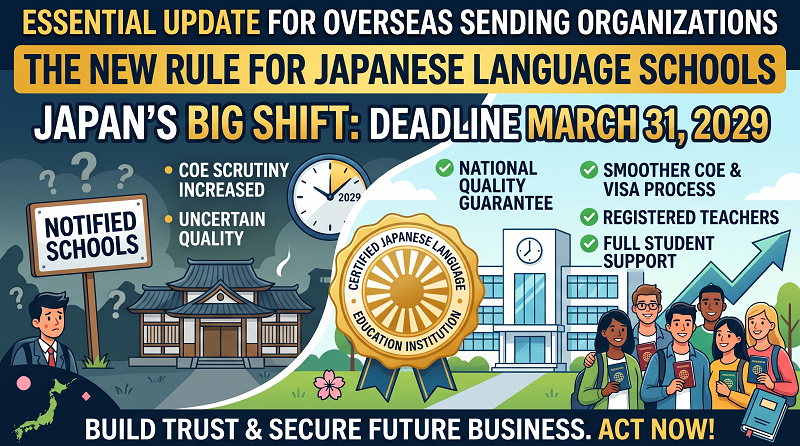
Starting April 1, 2029, schools will generally no longer be able to accept new international students under the “Student” residence status unless they hold status as a Certified Japanese Language Education Institution.
This change stems from a law enacted in Japan in 2023—the Act on Certification of Japanese Language Education Institutions for the Proper and Steady Implementation of Japanese Language Education—designed to guarantee the quality of Japanese language education at a national level.
Historically, most Japanese language schools operated as so-called “notified schools,” registered under standards set by the Immigration Services Agency.
Under the new system, however, schools must instead be reviewed by the Ministry of Education, Culture, Sports, Science and Technology (MEXT) across areas such as curriculum design, teaching staff, student support, and institutional management—and only those meeting the required standards receive certification.
A transition period is currently underway, and existing notified schools must obtain certification by March 31, 2029, if they intend to continue accepting international students afterward.
Only About 20% of Schools Are Certified So Far
In response to this shift, Japanese language schools nationwide have begun moving toward certification.
Yet of the more than 700 language schools believed to exist across Japan, only around 150 currently hold certified status.
In other words, more than 80% of schools are either still uncertified or currently undergoing the review process.
Among the schools that have achieved certification, several common traits stand out: curricula built around nationally defined standards, instruction centered on teachers holding the “Registered Japanese Language Teacher” national qualification, robust systems for tracking student attendance and enrollment status, and consistent support that spans from pre-admission screening through visa review and career or academic progression after graduation.
In short, certification represents a national push to transform language schools from institutions that simply “teach Japanese” into institutions that take responsibility for a student’s future.
Why This Matters for Overseas Sending Organizations
What makes this shift particularly important is that it isn’t only a domestic issue for schools in Japan.
Which school a sending organization refers a student to has a direct effect on how smoothly that student’s visa application proceeds—and on the quality of education and support that student ultimately receives.
In recent years, screening for the Certificate of Eligibility (COE) has grown steadily stricter, with far greater scrutiny applied to the clarity of a student’s study purpose, the reliability and reasonableness of their financial sponsorship, and the authenticity and consistency of submitted documents.
Because certified institutions are institutionally required to verify these factors from the very start of the admissions process, they tend to offer students, parents, and sending organizations alike a smoother path through visa screening and a more dependable choice of destination school.
Furthermore, once the April 2029 deadline passes, non-certified schools will no longer be able to accept new international students at all.
Building relationships with certified institutions now is therefore not a distant, abstract concern—it is a practical business question that will determine whether a sending organization can continue placing students in Japan reliably in the years ahead.
A Term Still Largely Unknown Overseas
Despite its importance, awareness of this system remains extremely low outside Japan.
For many students, parents, and even staff at sending organizations, the term “Certified Japanese Language Education Institution” is still unfamiliar.
While understanding of the system is gradually spreading within Japan, outreach to overseas audiences has been limited—leaving many to continue choosing schools the same way they always have, without recognizing the meaningful difference between a notified school and a certified one.
This information gap, however, is likely to become a real business risk for sending organizations before long.
While 2029 may still feel far off, reviewing school partnerships and rebuilding relationships with new institutions takes time.
Understanding the system correctly and establishing ties with certified institutions early not only prepares sending organizations for the transition ahead—it also builds trust with the students and families who rely on their guidance.
What Comes Next
The era of treating “any Japanese language school” as interchangeable is coming to an end.
Going forward, choosing where to send students will increasingly mean asking what kind of certification a school holds, and what kind of education and support system stands behind it.
For sending organizations and overseas language schools alike, what matters is not chasing short-term enrollment numbers, but understanding this systemic shift correctly and consistently choosing destinations that genuinely serve students’ long-term interests.
Adopting Certified Japanese Language Education Institutions as a standard part of school selection, starting now, will become the foundation for sustaining trust and long-term viability in the international education business ahead.
I can introduce you Certified Japanese Language Education Institutions!


コメント