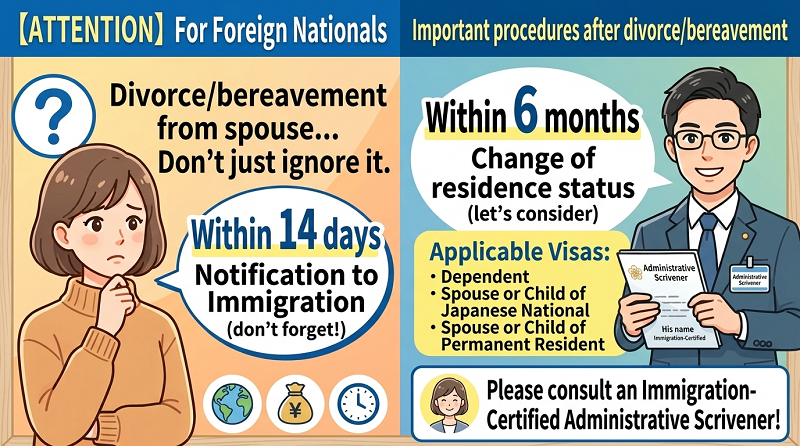
Divorce or the death of a spouse is one of life’s most difficult events.
During this emotionally difficult time, there’s an administrative procedure that foreign nationals often overlook. This is the “Notification Regarding Spouse” to the Immigration Services Agency of Japan, and in some cases, a required “change of residence status.”
Let’s walk through these two key points.
Report Within 14 Days of Divorce or Death of Your Spouse
If you hold one of the following statuses of residence as a mid- to long-term resident, you are required to notify the Director-General of the Immigration Services Agency within 14 days of the date your spouse passed away or your divorce became final.
Residence statuses subject to this notification requirement
- Dependent (家族滞在)
- Spouse or Child of Japanese National (日本人の配偶者等)
- Spouse or Child of Permanent Resident (永住者の配偶者等)
You can submit this notification online through the Electronic Notification System, in person at an immigration office, or by mail.
No supporting documents — such as a death certificate — are required.
It’s easy to think “I’ll get to it eventually,” but the 14-day deadline is strictly enforced.
Most people remember to notify their local municipal office, but the notification to Immigration is often forgotten.
Compliance and enforcement around residence status have become stricter recently, so this is worth taking seriously.
When Your Residence Status Loses Its Basis
Beyond the notification requirement, there’s an even more important issue.
Residence statuses such as “Spouse or Child of Japanese National” and “Spouse or Child of Permanent Resident” are granted on the premise that a spousal relationship exists.
This means that when that relationship ends — through divorce or the death of your spouse — the very basis for your residence status disappears.
This is fundamentally different from the “Permanent Resident” status. Because Permanent Resident status is not based on a spousal relationship, divorce or the death of a spouse has no effect on it.
However, if you hold “Spouse or Child of Japanese National” or “Spouse or Child of Permanent Resident” status, you will no longer be able to maintain that status once your spouse is gone.
Change Your Residence Status Within 6 Months!
If you lose the basis for your residence status because your spouse has passed away or you’ve divorced, you cannot simply leave things as they are.
You must obtain permission to change to another status — such as “Long-Term Resident” (定住者) — within 6 months.
If this 6-month period passes without action, it can become grounds for revocation of your residence status, and in the worst case, you may not be permitted to remain in Japan and could be forced to return to your home country.
Whether a change of status is approved depends on individual circumstances — how long you’ve lived in Japan, whether you have children and how they’re being raised, and whether you have an established base of life here, among other factors.
Approval is not automatic, but starting preparations early can improve your chances.
Note that the factors considered in a status change review may differ somewhat between cases of death and cases of divorce. In divorce cases in particular, the length of the marriage and the circumstances leading to the divorce may also be taken into account, so it’s important to prepare according to your specific situation.
Common Misunderstandings and Things People Overlook
“Divorce is different from death because it was my own choice, so the procedures must be different too”
→ Not true. The notification requirement and the need to change your residence status apply in largely the same way whether your spouse passed away or you divorced.
“I still have time before my residence period expires, so I should be fine”
→ Your residence period and the loss of your status’s basis are two separate issues. Even if your current period of stay hasn’t expired, losing the basis for your status can still make it subject to revocation.
Right after a divorce or the death of a spouse, people are often caught up in mediation, inheritance matters, and various administrative procedures — so notifying Immigration and changing residence status tend to fall by the wayside. But these are exactly the procedures with strict deadlines.
What You Should Check Right Now
- Confirm what type of residence status you currently hold (Dependent / Spouse or Child of Japanese National / Spouse or Child of Permanent Resident)
- If your status is subject to the requirement, submit the notification to the Immigration Services Agency within 14 days
- If your status is subject to loss of its basis, look into changing your residence status within 6 months
Divorce or the loss of a spouse places a heavy burden on anyone. That’s exactly why knowing about these procedures in advance — and consulting a professional early — can help protect your life in Japan going forward.
If you’re unsure about the residence status change process or what documents you’ll need, please reach out as early as possible.
I am a Gyoseishoshi (certified administrative scrivener) registered with the Immigration Services Agency for notification matters and can assist you with this process.
(If inheritance matters also arise, I can help with those as well, as a Gyoseishoshi.)
Contact Gyoseishoshi Office KAI, an Immigration Services Agency-registered administrative scrivener based in Kita-ku, Osaka.


コメント