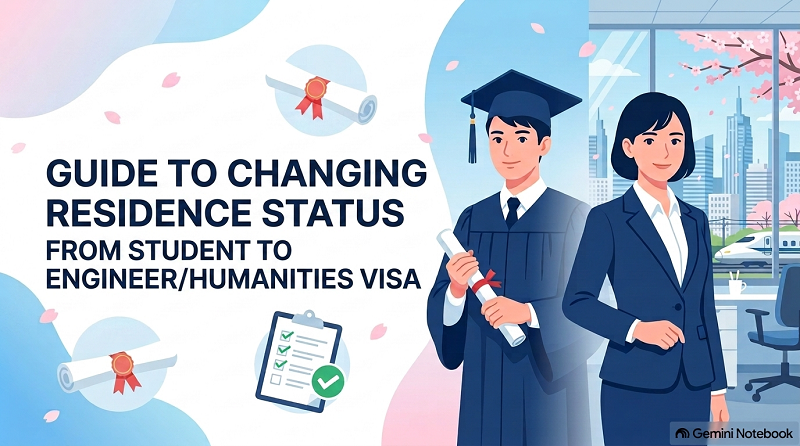
Congratulations on Your Job Offer — Now Comes the Visa Change
Congratulations on receiving your job offer for an Engineer/Specialist in Humanities/International Services (Gijinkoku) position.
After the long job-hunting process, it’s natural to feel relieved. But there’s one more important step before you can actually start working: changing your status of residence.
While you’re still on a “Student” visa, you cannot legally work full-time as a company employee.
Receiving a job offer does not mean you can start working right away — you can only begin once your application has been reviewed and approved by Immigration.
Some students put this off, thinking the hard part is over, only to find themselves rushing right before their start date.
Timing: When to Start, and the Deadline
Rather than waiting until graduation or your visa expiration date approaches, it’s best to start preparing as early as possible.
Many students begin the process once their employment contract details are finalized, typically from the start of the new year in their final year of school.
Since processing takes time, building in a comfortable margin is essential.
Documents issued by your school — such as your certificate of graduation or transcript — can sometimes take a while to obtain, so it’s a good idea to check with your school’s administrative office early.
Required Documents (What You Prepare vs. What Your Employer Prepares)
The application for change of status of residence requires documents from both you and your future employer.
Documents you prepare
- Application for Change of Status of Residence
- Passport and Residence Card
- Certificate of graduation (or expected graduation)
- Academic transcript
- ID photo
Documents your employer prepares
*depend on company
- Employment contract or job offer letter
- Company registration certificate
- Company’s most recent financial statements
- Materials describing the company’s business (e.g., company brochure)
Since the employer’s documents require coordination with your company’s HR or general affairs department, it’s wise to request them early.
Common Reasons for Denial
One of the key points Immigration examines closely for Gijinkoku applications is the relevance between what you studied and the actual job duties you’ll be performing.
If your major and your job description appear unrelated, the risk of denial increases significantly.
This scrutiny tends to be even stricter for graduates of vocational schools (senmon gakko), where the connection between coursework and job duties is examined more closely.
Even for roles like sales, where you might assume your major “doesn’t matter,” how the job duties are described — and how they’re worded in the employment contract — can significantly affect how the examiner interprets your application.
Vague descriptions of job duties in the employment contract can also lead to the position being classified as simple labor, resulting in denial.
Who Pays: You or Your Employer?
If you hire a gyoseishoshi (administrative scrivener) to handle the application, cost is a natural concern. There’s no legal rule dictating who must pay, and in practice it varies:
- The applicant pays, treating it as part of the job search process
- The employer pays, as part of recruitment costs or employee benefits
- The cost is split between both parties
To avoid misunderstandings, it’s best to clarify this in writing — in the employment contract or offer letter — before the application process begins. If you were hired through a recruitment agency, their terms may specify that the employer covers this cost, so it’s worth checking.
Applying Yourself vs. Hiring a Gyoseishoshi
| Applying Yourself | Hiring a Gyoseishoshi | |
|---|---|---|
| Preparation burden | You handle all document preparation and collection | Document checklists and preparation are handled for you |
| Risk of denial | Explaining the link between your major and job duties can be difficult | Documents are prepared with the examination criteria in mind |
| Time burden | You handle all Immigration office visits and any resubmissions yourself | Most of the process is handled for you, freeing time for work prep or moving |
| Cost | Application fee only | Application fee plus professional service fee |
If you’re unsure whether your major sufficiently relates to your intended job duties, or if you’re not confident about the wording in your employment contract, having a professional review it beforehand can significantly reduce your risk of denial.
In Summary
Receiving a Gijinkoku job offer is a major milestone, but the status of residence change application is an equally important step that remains. The connection between your field of study and your job duties is a key point of examination, and how the documents are written can affect the outcome.
If you’re unsure whether your major qualifies you for Gijinkoku status, or want someone to review your employment contract before applying, feel free to reach out for a consultation.
info@office-kai.net
コメント